![Bildmarke_only_positive.png]](https://support.3dspark.de/hs-fs/hubfs/Bildmarke_only_positive.png?height=40&name=Bildmarke_only_positive.png)
The Mixed Nesting feature enables users to optimize the arrangement of multiple different parts in one build job, significantly enhancing build volume optimization. In additive manufacturing scenarios, effectively arranging parts within a build chamber is crucial to reducing production costs and increasing throughput. This is particularly important when producing diverse parts in small quantities or prototyping multiple components simultaneously.
Real-world use cases frequently demonstrate the necessity of mixed nesting. For instance, manufacturers may need to print several distinct parts simultaneously to meet customer-specific orders, prototype batches of varied designs rapidly, or efficiently utilize expensive build materials and machine operation time. Without the ability to perform multi-part nesting, users often experience suboptimal part arrangement, leading to increased material usage, higher production costs, and reduced build chamber efficiency.
The feature for complete mixed nesting of parts is currently in development, which will allow users to select and nest multiple parts within a single machine.
In the meantime, you can simulate mixed nesting / hybrid nesting indirectly using 3D Spark. Please follow the steps outlined below.
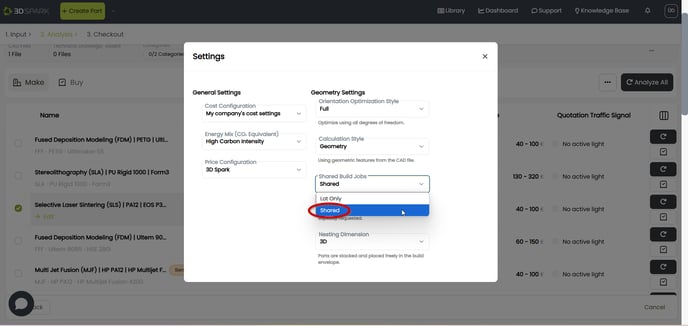
1- In the production option settings, select "Shared" under the "Shared Build Jobs" section. This option facilitates job packing by filling the available build envelope or print bed optimally with similar parts to the one currently analyzed. Consequently, production expenses are shared across multiple components, improving cost-efficiency.
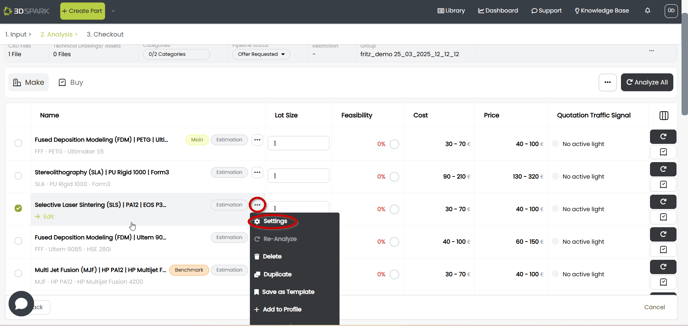
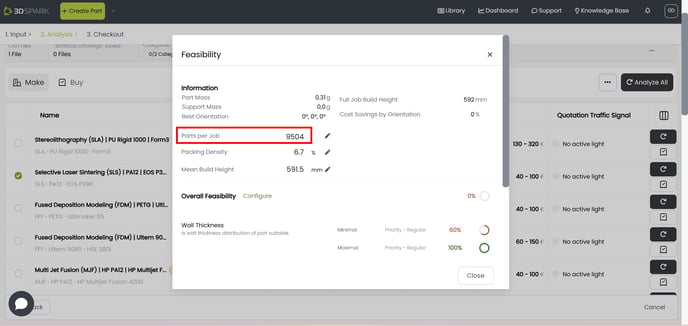
2- Within the "Feasibility" column, users can review how many parts can fit into a single build job. Adjust the maximum number of parts as necessary to achieve optimal packing density and volume utilization.
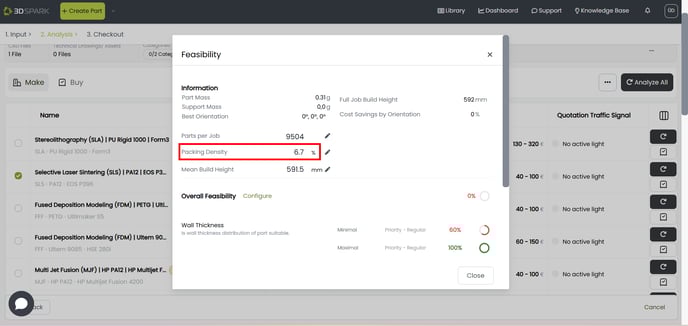
3- To refine calculations further, users can adjust the packing density (nesting density) parameter based on known averages for their specific machinery. Providing accurate nesting density inputs ensures precise cost distribution among the parts, optimizing print bed utilization and reducing material waste.
By leveraging these indirect methods of hybrid nesting, users can already realize notable improvements in cost estimates.