![Bildmarke_only_positive.png]](https://support.3dspark.de/hs-fs/hubfs/Bildmarke_only_positive.png?height=40&name=Bildmarke_only_positive.png)
A note from the developers before going into details
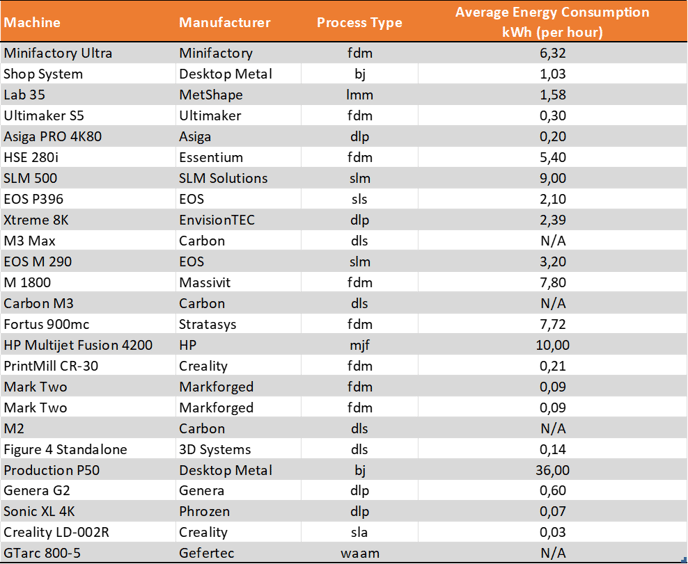
A critical part of the carbon footprint calculations is the average energy consumption of the machine. If you have added any custom machines, we recommend entering realistic energy consumption values for these machines.
Life-Cycle Stages That Are Included in the Carbon Footprint Calculation
- Embodied carbon of the feedstock
- Carbon footprint of the energy consumption of the 3D printer during the build process
- Pre- and post-process steps with significant carbon footprint
Calculation Details for the Machine
These equations are used to calculate the carbon footprint of a 3D printer, based on its energy consumption:
[Carbon footprint per lot]machine = [Pmachine] x [Build time per lot] x [Energy mix factor]
[Carbon footprint per part]machine = [Pmachine] x [Build time per lot] x [Energy mix factor] / [Lot size]
Explanation of the Parameters
[Carbon footprint per lot]machine: Total CO2 emissions of the machine energy consumption to produce the lot (unit: kgCO2eq)
[Carbon footprint per part]machine = Total CO2 emissions of the machine energy consumption to produce one part in this lot (unit: kgCO2eq)
[Pmachine]: Average energy consumption of the 3D printer per hour during the build-process (Unit: kW (calculated as [Average energy consumption per hour]= kWh/h = kW). Source: Machine manufacturers and peer-reviewed papers. If a manufacturer discloses the maximum energy consumption only, average energy consumption was calculated by an empirical factor of ~60%. See the table below for more information.
[Build time per lot]: Calculated via 3D Spark proprietary algorithms according to user input (Unit: hours)
[Lot size]: User input for the number of parts to be produced in this lot
[Energy mix factor]: By default, 3D Spark profile uses a moderate carbon intensity of 0.5 kgCO2eq/kWh. You can add your own energy profile in the organizational settings. As a guide, you can refer to Carbon Intensity of electricity per country data from OurWorldinData (Link) (We reached this link on 15.02.2023).
Calculation Details for the Feedstock / Material
For metals, embodied carbon is calculated based on feedstock production steps in the 3D Spark backend, with users viewing only the final result.
For polymers, embodied carbon is measured per kilogram of feedstock and is listed under material properties. Users can define this value for custom materials.
Calculation Details for Pre- and Post-Process Steps
Common industry values are used for the carbon footprint of many default process steps. Users can create custom process step templates and define the carbon footprint as either a fixed value or a formula.
IMPORTANT NOTE
Please use this tool responsibly. It is intended to provide sustainability insights for decision-makers, but we acknowledge that a complete Life Cycle Assessment (LCA) is complex and not easily achieved.
Assumed Energy Consumption of Selected 3D Printers
Additional Machines with More Information:
| Machine | Technical Specification | Peak Energy Consumption (per hour) | Average Energy Consumption* (per hour) | Reference |
| Bigrep One | 208 V – 240 V, 16 A, 50/60 Hz | 3.84 kWh | 2.3 kWh | Link |
| CR-3D I655IDEX | 3.6 kW | 3.6 kWh | 2.2 kWh | Machine |
| Ultimaker S5 | 500 W max. | 0.5 kWh | 0.3 kWh | Link |
| Fortus 450mc | 208VAC 3-phase, 50/60 Hz, 18 A | 6.48 kWh | 3.9 kWh | Link |
| Minifactory Ultra | 400V / 16A 3-PHASE | 11.1 kWh | 6.7 kWh | Link |
| Essentium HSE-1 | See linked spec page | 3.6 kWh | 2.16 kWh | Link |
| Formlabs Fuse 1+ | 230 V Wechselstrom, 7.5 A (eigener Stromkreis) | 1.725 kWh | 1.04 kWh | Link |
* Average Energy Consumption = Manufacturer specification or estimated at 60% of peak energy consumption.
Assumed Carbon Footprint of Selected Feedstock
Filaments
Powders
| Material | Estimated Embodied Carbon (kg CO₂e/kg) | Material Form |
| PA11 | 4.2 | Powder |
| PA12 / Nylon12 | 4.2 | Powder |
| PA12 CF | 7.5 | Powder |
| PA12 FR | 7.5 | Powder |
| TPU | 4.4 | Powder |